
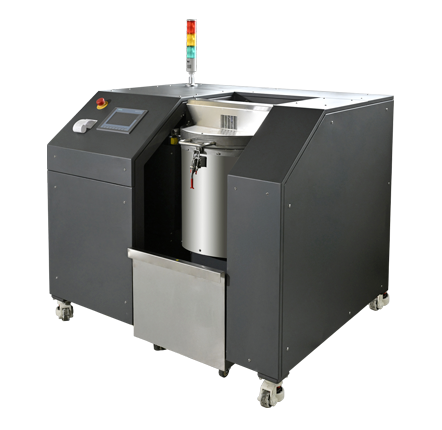
Sterilwave 50
up to 10 kg/hour
approx. 24,3 tonnes/year
View product specifications →
Sterilwave model overview
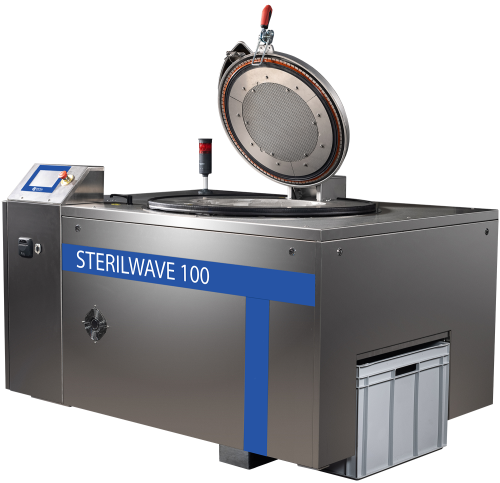
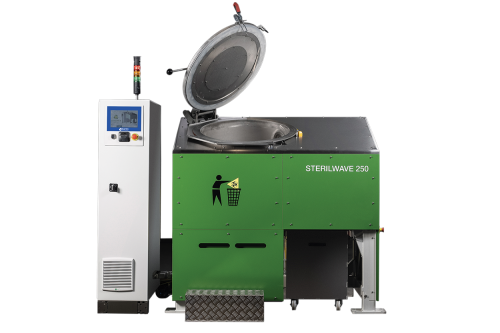
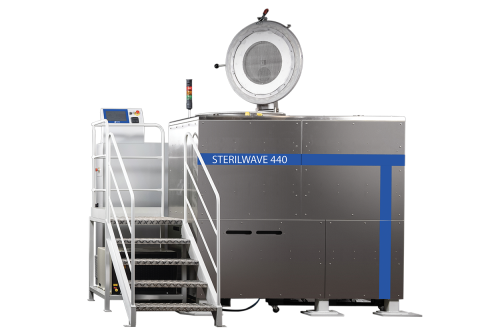
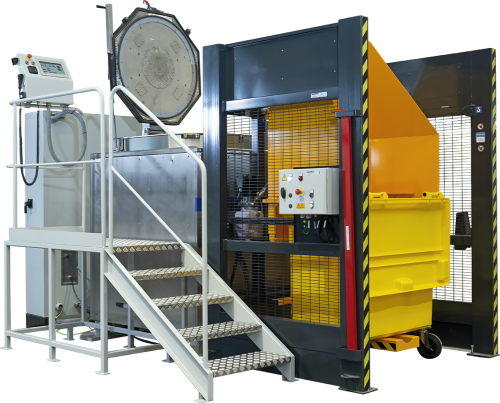
Calculation basis: maximum processing capacity in kg/hour, 8 hours per day and 304 operating days per year. Actual capacity may vary.
Model selector and savings calculator
Enter your estimated annual waste volume to see the required capacity, an initial model recommendation and the indicative saving.
20.6 kg/hour required
Recommended configuration
Up to 50 kg/hour
Average requirement: 41% of available capacity
Initial indication based on average load. Peak capacity, waste profile and required availability are assessed in the follow-up review.
Indicative annual saving
€42,800Example assumptions: €1.04/kg externally, €0.23/kg after treatment and 80% residual weight. Excludes investment, energy, labour, maintenance and financing.
Additional benefit from the Sterilwave 250 upwards
The box costs approximately half the price of a standard container and its lower tare weight also reduces the waste weight presented for treatment.
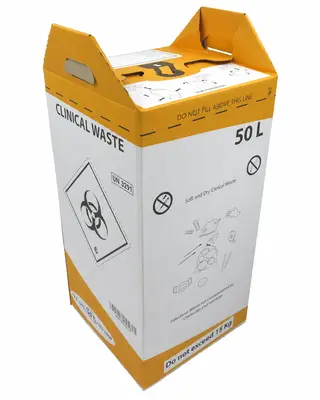
Calculation basis: container price €9 to €14 excluding VAT, box price 50% of that amount and one box replacing one container. A 50-litre container may hold a maximum of 25 kg and is normally filled to 80% to 85%. Liquids are limited to 5 litres with sufficient absorbent material. Actual suitability depends on waste classification, contents, closure and the applicable packing instruction.
Would you like to know what this estimate means for your organisation?We assess the waste profile, peak load, operating hours and costs for your organisation.
Discuss your calculationThe decontamination process
Indicative points in the cycle; dependent on model, load and configuration.
Waste acceptance
Eligible
Specific assessment
Different disposal route
Independently supported
Confidence comes from microbiological evidence and a controlled, validated process
During shredding, microwave energy heats the waste to at least 110 degrees Celsius. This kills bacteria and inactivates viruses.
Healthcare-waste research using Bacillus atrophaeus confirms that spores can be inactivated when moisture, energy dose, temperature and treatment time are controlled.
Shredding, cycle parameters and result recording form one controlled process. Biological indicators and on-site validation provide evidence for the intended waste stream.
PLC control and traceability
Operator involvement typically 5 to 10 minutes per cycle
Shredding and microwave treatment follow preset process logic
Cycle and result data for quality assurance and traceability
Manual or automatic, depending on model and configuration
IP connection for monitoring, diagnostics and maintenance